It is a pattern I see most weeks in the treatment room: a client arrives at 6pm with a neck that feels “stuck”, a headache settling behind one eye, and the assumption that something in the neck itself has gone wrong. Almost always, the neck is not the problem. It is the messenger.
We spend hours a day holding a screen at eye level that is not at eye level, breathing shallowly into the upper chest, and loading one shoulder more than the other. The neck absorbs all of it, quietly, until it cannot.
It is usually not the neck itself
The neck is a remarkably mobile structure — and a fairly small one. It sits between two heavy, opinionated neighbours: the shoulder girdle above and the rib cage below. When either stops doing its share of the work, the neck picks up the difference.
Two examples show up constantly:
- The shoulder that has stopped helping. If the shoulder blade does not rotate upward when you reach overhead, the neck has to borrow movement it does not have. The upper trapezius tightens, the joint at the base of the skull gets compressed, and the headache starts.
- The rib cage that has stopped moving. When the mid-back is stiff and the breath stays high in the chest, the accessory breathing muscles — scalenes, sternocleidomastoid — work overtime. These attach directly to the cervical spine. They are not designed for shifts that last all day.
Muscles do not usually shorten because they are lazy. They shorten because they have been asked to do a job that belongs to someone else.
Three signs the problem sits in your shoulders
- Your neck feels better after you move your shoulder. Reaching, rolling the shoulder blade or hanging the arm often gives a few minutes of relief — a clue that the neck was compensating.
- One side is always tighter. Mouse arm, phone arm, bag arm. If the tension is consistently on one side, look at what that arm does for hours at a time.
- Deep breath changes the sensation. If a fuller breath into the ribs eases the tightness at the base of the neck, the rib cage is part of the story.
What actually helps
Posture is not a shape you can hold correctly for eight hours. It is a rhythm. The goal is not to sit perfectly — it is to change position often enough that no tissue is loaded in the same way for too long.
- Move every 30 to 40 minutes. Not a workout. Standing up, rolling the shoulders, taking three slow breaths is enough to change the load.
- Let the screen come to you. Screen at the top of the monitor, roughly at eye level, an arm’s length away. Laptop-only work is the single most common driver I see.
- Load the mid-back a little. A few minutes of thoracic extension over a rolled towel, or a simple wall angel, restores movement the neck has been borrowing.
- Strengthen rather than stretch only. Stretching feels good and is temporary. Building tolerance in the shoulder blade and deep neck flexors is what changes the pattern.
- Sleep position matters. If you sleep with your chin tucked toward your chest, you undo the day’s work every night. A pillow that keeps your head level is not a luxury.
A two-minute reset you can do at your desk
- Breathe into the back ribs for five slow breaths, hands on the lower ribs. Let the ribs widen sideways rather than lifting the shoulders.
- Slide the shoulder blades down and back ten times, without shrugging. Small range, slow.
- Look over each shoulder — five times per side, turning the whole spine, not just the neck.
- Stand and reach one arm overhead, let the rib cage follow, then switch. Ten seconds per side.
None of this is dramatic. That is the point. The neck responds to frequency far more than intensity.
When it is time to book an assessment
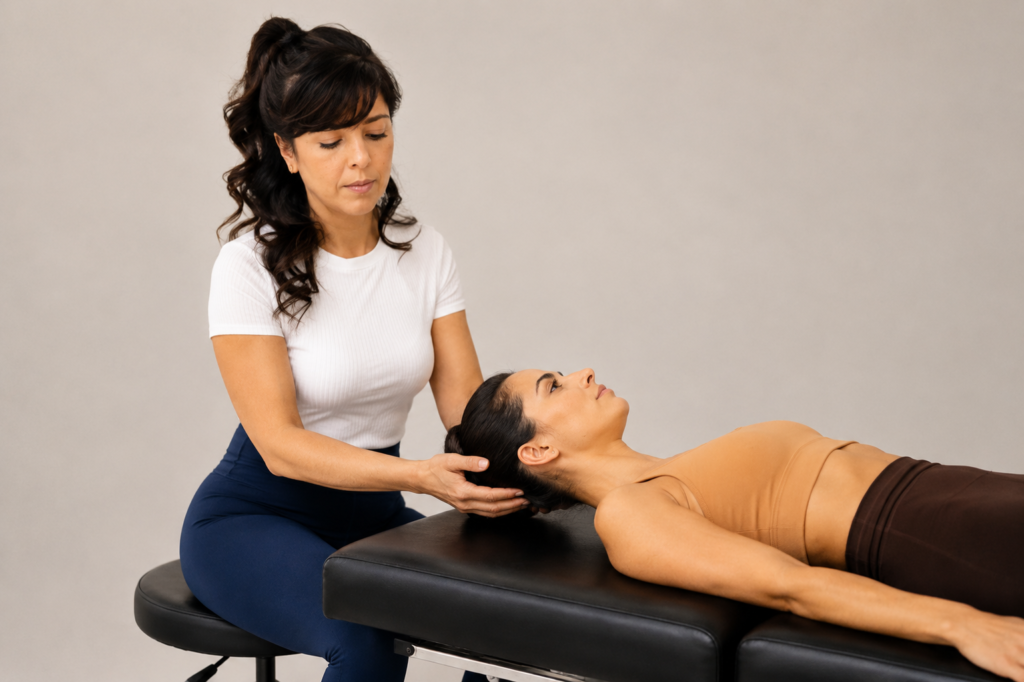
If the tightness now comes with numbness, tingling into the hand, dizziness, or a headache that wakes you, it is worth having it looked at properly rather than stretching around it. In an assessment we look at how the shoulder, rib cage and neck move together — and we treat the one that is not doing its job, which is often not the one that hurts.
If you would like to understand your own pattern, a session is a good place to start. We will assess first and treat second, so you leave knowing what to do on the days you are not here.